
Urban Arrow Family vs Tern GSD: How to Choose
You ride a GSD. You pilot an Urban Arrow.
I say that in the shop a lot, because it’s true.
The Tern GSD is a bicycle. A long, strong, heavy duty one, but you throw a leg over it and it behaves like a bike you already know how to ride. The Urban Arrow is a different animal. There’s a box between you and the front wheel, the steering runs through a linkage, and you’re not so much riding it as operating it. Thirty seconds in you stop thinking about that. But the first thirty seconds feel like taking command of something.
I’ve spent years on front loaders. I’m not neutral about them and I’m not going to pretend to be. What I can do is tell you what I tell people standing in the shop, which is that these two bikes solve the same problem in ways different enough that the answer usually comes down to four questions about your life, not four questions about the bikes.
| Urban Arrow Family | Tern GSD | |
|---|---|---|
| Starts at | $7,999 | $4,999 |
| Carries kids out of the box | Yes, bench and belts for two | No, add a Clubhouse and pads |
| Kit to match | Nothing needed | $780 set up properly |
| Kids it suits | One to three, roughly 0 to 5 | Up to two, 0 to 16 and up |
| Three kids | Yes, $279 extra bench | No, deck is rated for two |
| Storage | Long, needs a real spot | Folds, stands on its tail |
| In a car | Truck or minivan, seats down | Goes on a hitch rack |
| Torque | 85 Nm, 100 on the Next Pro | 85 Nm across all four builds |
| Drivetrain | Enviolo hub and belt, one way | Chain, Enviolo or Rohloff by build |
| Rain gear | Raincover Plus, $419 | Storm Shield, $265 |
| Real-world gap | $1,220 against the P00. $2,220 against the P10. | |
| RI rebate | $350, or $750 income qualified. Both qualify. | |
What’s it like having your kids in front of you?
This is the whole case for the Urban Arrow and it’s not a spec.
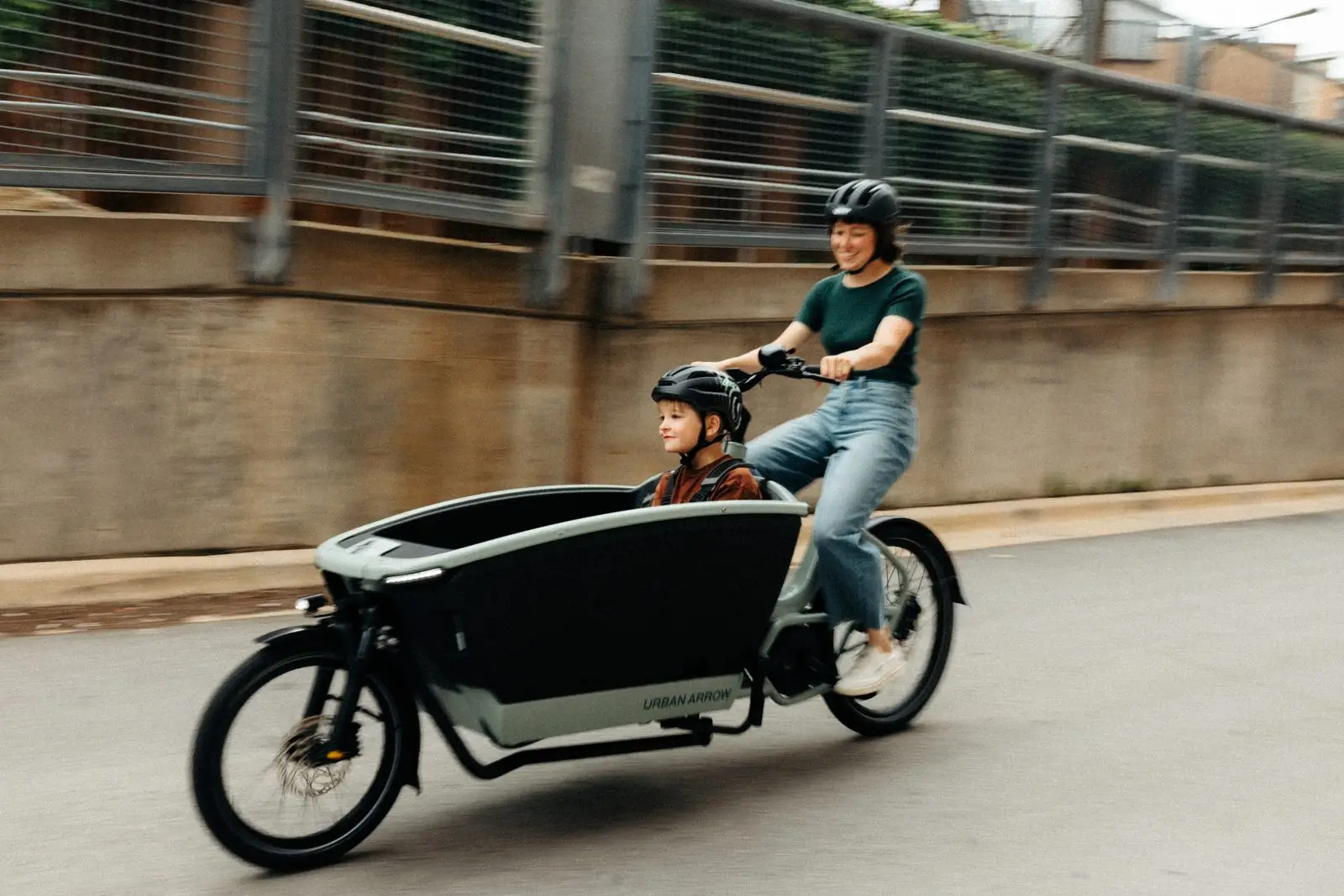
They’re right there. You can talk to them at a normal volume. They hand you snacks. You can see what they’re pointing at, which means you’re having the same ride they’re instead of narrating it over your shoulder. And when it goes quiet, you don’t have to turn around to find out why, because there’s no back there.
As a new parent, the box felt safe and secure to me in a way I didn’t expect. Two walls and a bench, kids strapped in, everything inside my field of view. I want to be careful how I put that, because "feels safe" and "is safer" are different claims and I’m only making the first one. But it’s a real feeling and it’s why a lot of families walk in asking about this bike by name.
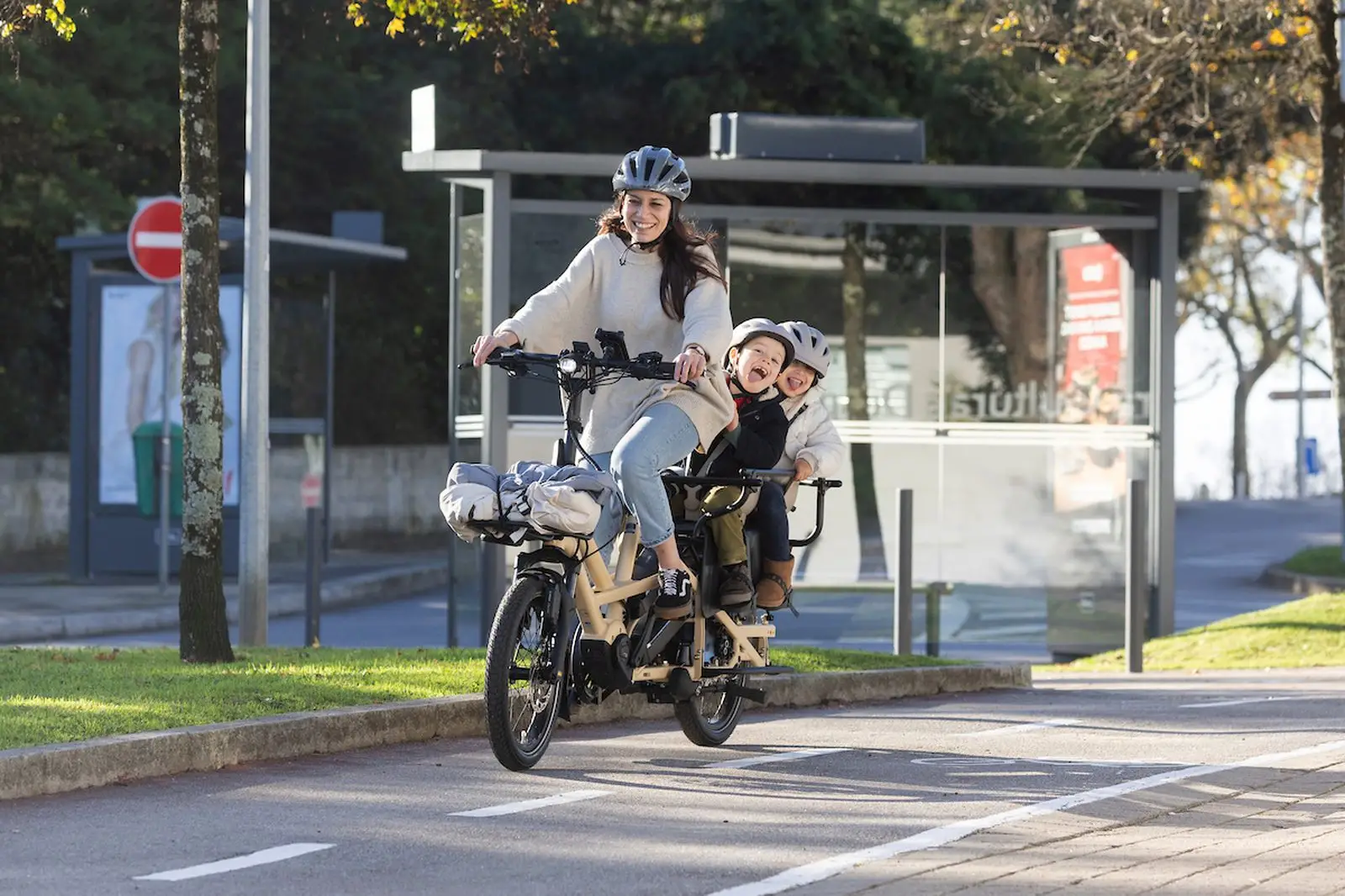
The GSD puts the kids behind you, on a padded bench with a Clubhouse around them. It works, kids love it, and plenty of families run that setup every day. It’s just a different relationship. You’re the driver and they’re passengers. On the Urban Arrow you’re all in the same room.
Are you a bucket person or a longtail person?
This is the question I’d ask you first if you walked in today, and it sorts more people than anything else on this page.
The box doesn’t require you to be organized. You open it, you put things in it, you go. Your kid wants to bring the scooter and also every truck they own? Fine, toss them in. A grocery run turns into a hardware store run turns into picking somebody up from a friend's house? The box doesn’t care. It’s a container, and containers are forgiving.
A longtail asks more of you. You’re strapping things down, you’re using panniers and baskets and a front rack, and you end up with a system. This bag is for that, those go here, the straps live there. Once the system exists it works beautifully and the bike carries more than people expect. But you have to build it and you have to keep it up.
There’s a version of this that shows up on day one. An Urban Arrow is more or less ready to go when you pick it up. The bench is in the box, the belts are on it, and you can load a kid into it on the sidewalk out front and ride away. A GSD you configure. Which Clubhouse, which pads, Stow Decks for their feet, what’s carrying the groceries. That’s a good conversation and it ends with a bike set up exactly for your life, but it’s a conversation, not a handoff.
Some people love that. They like having a place for everything and they’re good at it. Other people know themselves well enough to know that a system they have to maintain is a system they will quietly abandon by April.
Neither answer is the better one. But know which one you are, because it predicts how much you’ll use the bike.
Is the Urban Arrow hard to ride?
No, and this is the single most common thing people get wrong before they ride one.
It looks like it would be a handful. It’s long, there’s a box out front, and the first impression is that it must be tippy. The opposite is true. The load sits low and between the wheels, so the center of gravity is below your hips instead of above them. A loaded Urban Arrow feels more planted than an empty one, and it’s easier to ride with two kids in the box than most people expect a normal bike to be with one kid on the back.
The part that takes adjusting is the steering. The linkage means the front wheel doesn’t respond the way you’re used to, and at very low speed you steer with small inputs instead of big ones. It takes about a block. I’ve handed this bike to people who had never been on a cargo bike and watched them come back around grinning.
If you take one thing from this page: don’t decide about the Urban Arrow from a photograph. It rides better than it looks.
Will either one get you up Providence hills?
Yes. Both of them, loaded, with kids aboard.
The GSD and the Urban Arrow Family both make 85 Nm of torque. Same number, same Bosch Cargo Line motor, and they climb about the same. The FamilyNext Pro steps up to 100 Nm, and you feel that. You notice it the first time you put a foot down on a grade with the bike loaded.
I’m not going to name a specific street and tell you what it does, because it depends on how much weight is in the bike, what gear you’re in and how hard you feel like working that day. What I’ll say is that the hills here are the reason people in this city buy electric cargo bikes instead of regular ones, and none of the bikes on this page is going to be the thing that stops you.
Where are you going to keep it?
This is where the GSD wins.
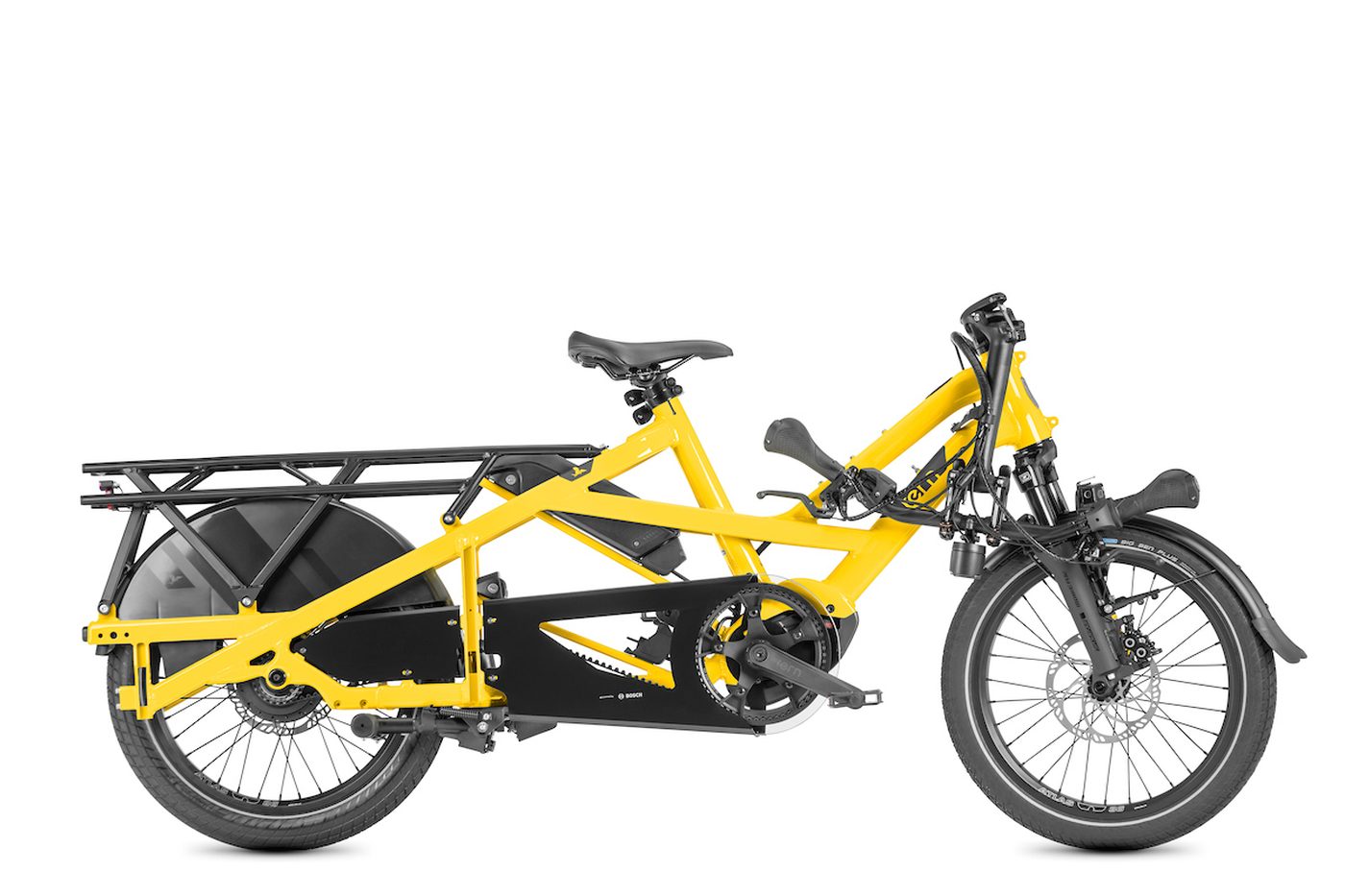
A GSD folds. The bars drop and the bike stands up vertically on its tail, which means it fits in a hallway, a corner of a loft, the end of an apartment entry, a spot in the garage where a bike that long has no business fitting. A lot of young families in Providence are in apartments, second floors and lofts. For those families this isn’t a nice feature. It’s the difference between owning a cargo bike and not owning one.
The Urban Arrow doesn’t do that. It’s long, it stays long, and you need a real place to put it. Both bikes can live outside and both are built for it, but both are better under a roof, and one of them needs more roof than the other.
Then there’s moving it when you’re not riding it, and this is a real split. A GSD will go on a hitch rack. The Urban Arrow won’t. For that one you’re looking at a truck, or a minivan with all the seats down, and you’re going to want a second set of hands. If part of your plan involved the bike coming to the beach house a few times a summer, sort that out before you buy rather than after.
What happens when your kids get bigger?
This is the argument almost nobody makes and it’s the one I’d want to hear if I were the one buying.
The Urban Arrow box is sized for small kids. That’s what makes it great and it’s also what limits it. Somewhere around eight, nine, ten, depending on the kid, they start running out of room in there. It’s going to get small for them. That’s not a knock on the bike, it’s the dimensions of the box.
The GSD's rear deck doesn’t have that ceiling. Little kids ride back there in a Clubhouse with a seat pad, with Stow Decks under their feet. Bigger kids ride on the bare deck holding the grab bars. A teenager rides it, and so does an adult, because the rack is rated for 220 pounds and the bike is rated for 463 pounds gross.
If the kid you’re buying this for is two, the Urban Arrow is going to be wonderful for about six years. If they’re six, think hard about what this bike is doing when they’re twelve.
What about rain, and what about February?
Both bikes have a real answer for weather, and both answers are add ons, so budget for them.
On the Urban Arrow, the Raincover Plus goes over the box and turns it into a little room. Kids stay dry. It’s $419, it’s the accessory we sell most for that bike, and for New England I’d treat it as part of the purchase rather than an upgrade.
On the GSD the rain answer is the Storm Shield, a canopy that goes up over the Clubhouse. It’s $265 and it’s rated for two passengers up to 4 foot 7. Separately, the Storm Box mounts at the rear around the Clubhouse and switches between hauling kids and hauling cargo, which is where you get a little of that bucket bike feel on the days the kids aren’t aboard. Tern calls the three of them together the Clubhouse Fort. Worth noticing that on rain gear specifically the Tern is the cheaper one.
Either way, put a blanket in there. Not for safety, not for weatherproofing, just because a kid sitting still in 38 degrees gets cold in a way a kid pedaling doesn’t. It’s the cheapest thing on this page, and it’s what keeps your family riding in March.
How many ways can you build each one?
The GSD comes four ways. The P10 at $4,999 runs a Shimano Deore 1×10 drivetrain and a 500 Wh battery, with a second battery bay if you want to double your range later. The P00 is $5,999. The S10 at $7,999 moves to a 545 Wh battery and adds Bosch ABS. The R14 at $10,999 gets a Rohloff E-14 hub with a belt drive, an 800 Wh battery and ABS. All four run the Bosch Cargo Line motor at 85 Nm, and all four fit riders from 4 foot 11 to 6 foot 7, which matters more than people expect in a house where two adults of different heights share one bike.
The Urban Arrow Family comes two ways. The Cargo Smart System build is $7,999, with a 545 Wh battery, 85 Nm and an Enviolo Heavy Duty hub on a Gates belt. The FamilyNext Pro is $8,999, with the Bosch Gen 5 motor at 100 Nm, an Enviolo Extreme hub, a rated maximum of 550 pounds with 275 of that in the box, seating for up to four, and the bench and belts for two included.
One thing most comparisons miss: Underneath, the Urban Arrow comes one way: a stepless Enviolo hub on a Gates belt. No derailleur, nothing to index, no chain to oil, and it shifts while you’re standing still, which you’ll appreciate at every red light with a loaded bike. On the GSD you choose. The P00 is that same setup. The P10 and the S10 run a chain and a derailleur instead, which is cheaper to buy and cheaper to fix, and it’s also a derailleur hanging off the back of a bike that lives near curbs, kid feet and bike racks. The R14 goes the other direction with a Rohloff, the nicest drivetrain on either bike and priced like it.
So if low maintenance is why you’re looking at an Urban Arrow, the GSD to compare it against is the P00, not the P10.
What do they cost, and does the Rhode Island rebate cover them?
Entry to entry, the GSD P10 is $4,999 and the Urban Arrow Family is $7,999. Three thousand dollars apart.
Except those two numbers aren’t describing the same thing. An Urban Arrow works with nothing added to it. The box, the bench and the belts for two are already there. You pick it up, you put a kid in it, you ride home. There’s no version of that with a bare GSD. Out of the box it’s a long strong bike with a rack on the back, and until you add a Clubhouse and pads it’s not carrying your kids anywhere. The $4,999 is the price of the platform, not the price of the bike you’re picturing.
Here’s what the kit costs, at MSRP. Clubhouse Gen 4 is $260. A backrest is $45 and a seat pad is $40, which you want if a kid is going to sit back there for more than ten minutes. Stow Decks are $170. A Storm Box is $265. That’s $780 to set a GSD up the way I’d set one up, and $345 is the bare minimum to get one kid riding comfortably. If your kid is still small enough to need a real child seat, a Thule Yepp 2 Maxi is another $250.
Now run it the way you’d buy it. A P10 set up properly is $5,779 against $7,999 for a bike that needs nothing. That’s a $2,220 gap. Against the P00, the belt and Enviolo build that’s the fair comparison, it’s $6,779 against $7,999. Twelve hundred dollars. Add rain gear to both sides and it drifts back a little, since a Storm Shield is $265 and the Raincover Plus is $419, which puts a rain-ready P00 at $7,044 against $8,418. Call it fourteen hundred.
Fourteen hundred is real money, and for plenty of families it settles the whole thing. It’s not three thousand, and anybody deciding between these two off the sticker prices is comparing the wrong pair of numbers.
The accessory math doesn’t only run against the Tern, either. If you have three kids, an extra bench for the Urban Arrow box is $279 and you’re finished. A GSD's deck is built for two and the Clubhouse is rated for two passengers, so three kids is the point where this stops being a comparison at all. That’s the one place on this page where one of these bikes is simply the answer.
Both qualify for Rhode Island's e-bike rebate, the Erika Niedowski Memorial Electric Bicycle Rebate Program. It’s $350, or 30% of the purchase price, whichever is less, so on any bike here it’s $350. If you’re income qualified it goes up to $750, or 75%, whichever is less, so $750. You need to be a Rhode Island resident, at least 18, buying a new Class 1, 2 or 3 bike, and e-cargo bikes count. Full details are on our Rhode Island e-bike rebate FAQ.
Who shouldn’t buy an Urban Arrow?
I’d rather say this before you spend the money than after.
If your kids are five and six, think hard. This is an $8,000 bike and you want years out of it. With a five and a six year old you might be looking at three or four more seasons of them wanting to sit in that box, and then you own a bike built for a job nobody in your house needs anymore. The same money in a GSD keeps working until they’re driving themselves places.
If you don’t have a place to keep it, think about that before you buy. And if part of your plan involved putting a cargo bike in the car a few times a summer, this isn’t the bike for that plan.
Where the Urban Arrow makes the most sense is one, two or three kids in the zero to five range. That’s the window, and inside it there’s nothing else like this bike. The GSD works from zero to sixteen and up, which is a different kind of value and a longer one.
Then there’s a third group and I’m not going to pretend otherwise. Some people come in because they think front loaders are cool and that’s the bike they want. That’s a perfectly good reason to buy a bike. If that’s you, I’m not going to talk you out of it. I just want you walking in with the tradeoffs in front of you so you’re picking them on purpose.
So which one should you get?
I’m not going to tell you, because I don’t know you yet.
If you’re still torn after reading all of that, go back to the bucket question. Whether you want to throw things in or you want a place for everything tells you more than the price difference does.
What I’ll tell you is where I land. I think the Tern is the more practical choice. It’s less money, it folds up and stands in a corner, it fits riders of nearly any size, and it carries your kid through high school instead of through second grade. On paper it wins most of this page.
And most of the people who buy an Urban Arrow aren’t sold by anything on this page. They’re sold by the ride. It doesn’t feel like riding an e-bike. It feels like something else, and that’s not a thing I can put in a table for you. The kids up front, the conversation, the low planted feel of it loaded. I’ve had that bike in my life, and a spec sheet doesn’t capture it.
One more thing, since it’s brand new
Urban Arrow built a longtail. It’s called the Breeze, it’s $6,999, and it runs the same Bosch Cargo Line motor at 85 Nm and the same 545 Wh battery as the Family, on a shorter step-through frame with a rack on the back instead of a box in front. Total capacity is 441 pounds with 176 of that on the rack, so a bit less than a GSD. A passenger bar and two seat cushions come with it.
If the bucket question earlier landed you on the longtail side but everything you like here’s the Urban Arrow part, that’s the bike to ask me about.
I haven’t put real miles on one yet. So I’m not going to tell you how it rides, or how it stacks up against a GSD, because I don’t know, and you’d be right not to believe me if I pretended otherwise. What I can do is let you ride it before either of us has an opinion about it. See the Urban Arrow Breeze.
Come ride both
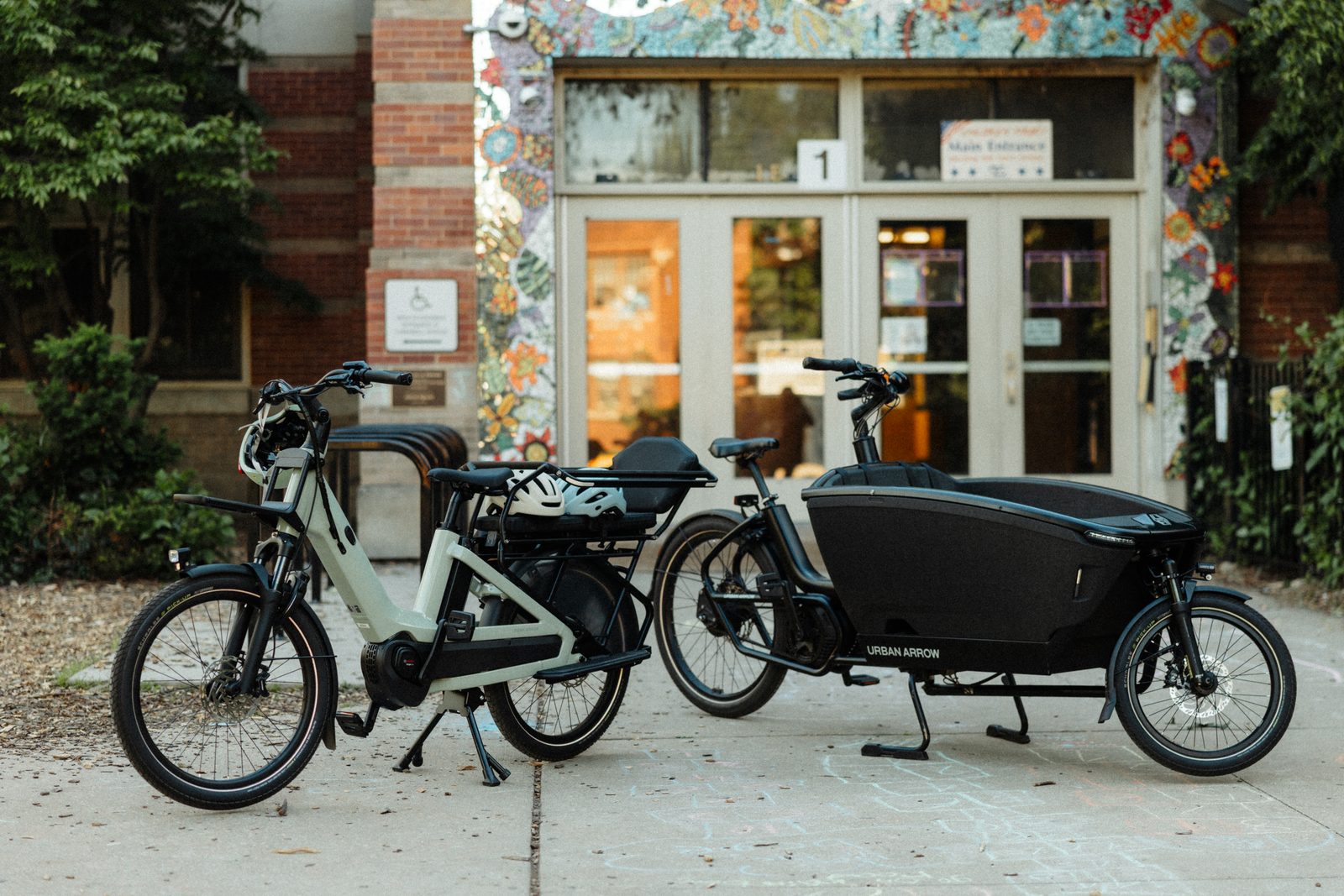
We keep both bikes in stock at 181 Brook Street in Providence, so you can ride them back to back in the same hour instead of driving to two shops and comparing memories. Customers drive in from Boston to do exactly that.
Call or text first so the bikes you want are charged and out of the rack, or book a test ride.
Bring the kids. Put them in the box, put them on the deck, and see which one they don’t want to get out of. That will tell you more than I can.